I grew up in a Southern Baptist Church, attending missions classes: Mission Friends in preschool, Girls in Action (GAs) in elementary, and Acteens as a teen. These graded missions classes fell under the leadership of Women’s Missionary Union (WMU).
Because of these classes, and also because of having family members on the mission field, I learned early in life the importance of supporting missionaries through prayer and giving.
Fast forward to now: Over the years I have often found myself in the role of Missions teacher at our church’s Vacation Bible School. This year I decided to include some information about the Lottie Moon Christmas offering for the International Mission Board and the Annie Armstrong Easter Offering for the North American Mission Board.
I ended up showing a short video about each of the ladies honored by these two offerings. I also ordered some books from the library about Annie Armstrong, which did not arrive in time to use at VBS. However, I did finally get around to reading them myself!
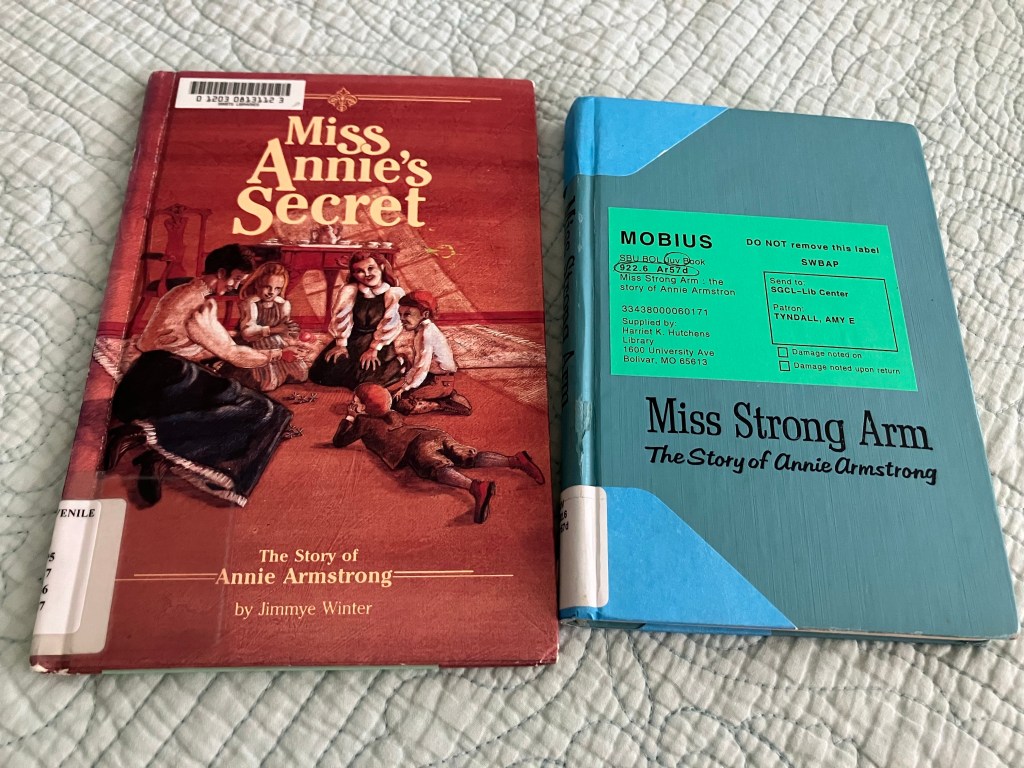
Despite the fact that I have known the name Annie Armstrong my entire life, I didn’t know much about her life work. She was a contemporary of Lottie Moon, the famous missionary to China. Lottie and others encouraged Annie to organize Baptist women into societies to support mission work in the United States and abroad. Annie successfully organized Maryland women into a state society, by taking the train to every Baptist church in Maryland and personally urging the women to help the cause of missions.

Her next goal was to organize the women convention-wide. During the post-Civil War era, this would have meant the southern states. She and her supporters ran into some opposition at the Southern Baptist Convention, whose leaders thought the women were vying for power. But it was just a few more years before the women’s good intentions were realized, and the Women’s Missionary Union was established as an auxiliary organization to the Southern Baptist Convention.
Annie was basically the Energizer Bunny of the late 19th century. She oversaw the publication of pamphlets telling churches about missionary work, wrote thousands of letters, visited churches, worked with orphans and German immigrants in her home city of Baltimore, sent “Missionary boxes” (sounds a lot like Operation Christmas Child!) to newly displaced Osage children in Oklahoma, and rode a train to Oklahoma and later Mexico to visit her “substitutes,” her name for missionaries on the field. She even partnered with Black churches in Baltimore, which I assume was uncommon at the time.
She worked tirelessly, refusing a salary. Near the end of her 18 years as corresponding secretary for WMU, there was a misunderstanding between her and some other women about opening a training school for women missionaries. She was deeply hurt, but instead of defending her position and risking causing division in Women’s Missionary Union, she quietly stepped down and let younger leaders take charge. In her elder years, she received word that a new offering would be named after her. At that time it was called the Annie W. Armstrong Thank Offering for home missions.
It would be hard to overstate Annie Armstrong’s importance in Baptist history and her importance in helping the SBC mission boards to thrive and grow. Even I, a hundred years later, was a beneficiary of her work in establishing graded mission programs for children. She is truly a hero of the faith.

 Amy's Garden
Thanks for sharing. I remember my GA days which made me feel like I could make a difference.
Sent from Yahoo Mail for iPad
LikeLike